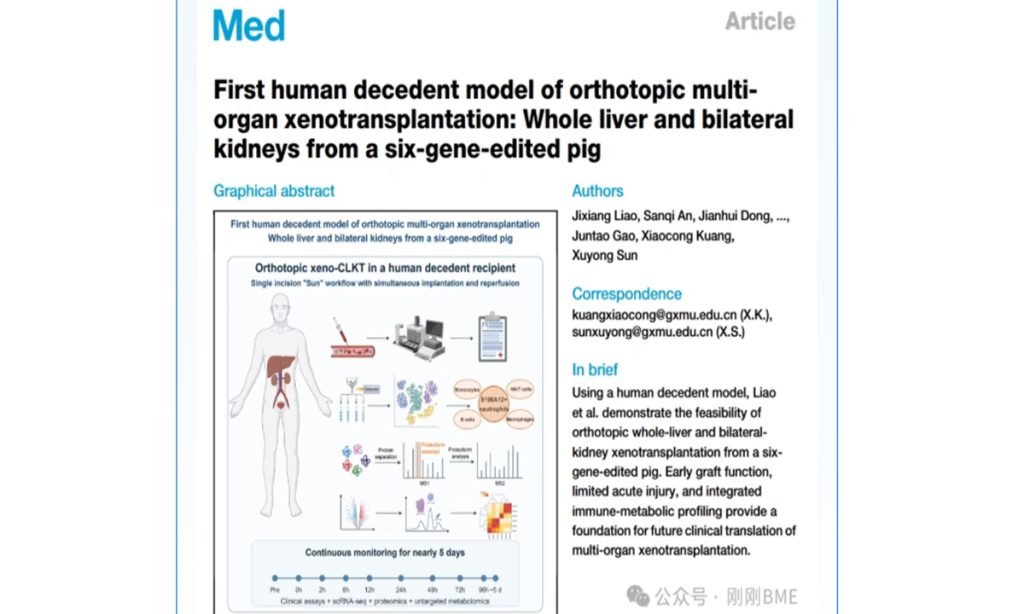
A Chinese medical team has reportedly performed the world's first combined xenotransplantation of a gene-edited pig liver and two pig kidneys into a human body, marking a huge milestone in the exploration of multi-organ xenotransplantation.
According to a post on the official WeChat account of the Second Affiliated Hospital of Guangxi Medical University on Monday, the procedure was carried out by a medical team led by Professor Sun Xuyong from the hospital and involved an orthotopic transplant, meaning the organs were placed in their normal anatomical positions. The recipient was a 53-year-old brain-dead man, and the surgery was performed with the consent of his family.
The team used gene-edited Bama miniature pigs from Guangxi as the source of the donor organs. The donor pigs underwent six precise genetic edits, including the removal of key genes that can trigger hyperacute rejection in humans and the insertion of human genes related to blood clotting and immune compatibility, the Xinhua News Agency reported on Wednesday.
During five days of systematic monitoring, the transplanted organs showed encouraging physiological signs, with generally normal blood supply as well as observed bile secretion and urine production, according to the post.
The research was published in Med, a Cell Press journal, on May 29, 2026, and was later featured by Nature, drawing wider attention from the global academic community, media reported.
Leonardo Riella, a physician-scientist at Harvard University and Massachusetts General Hospital who led the team behind the world's first living-recipient pig kidney transplant in 2024, said multi-organ xenotransplantation is more complex than single-organ transplantation, but the study showed that it is technically feasible.
Set to be held in the US, Canada and Mexico from June 11 to July 19, this year's World Cup tournament will see 48 teams contesting for the first time in the tournament's history. Although the Chinese men's national soccer team did not qualify for the World Cup, the country's presence will be palpable.
With less than a week before kickoff, this year's World Cup has yet to generate strong buzz in China, possibly due to time zone differences and other factors. But there is no such lag for Chinese companies, which are already engaging with the event at a higher and more advanced level.
China's footprint at this year's World Cup highlights a shift from low-cost manufacturing to stylish, original designs, alongside the contribution of Chinese referees and officiating technologies. This evolving role is driven by innovation and advanced technology. Guy-Laurent Epstein, UEFA events marketing director, told the People's Daily that Chinese companies are no longer mere commercial sponsors buying ad space, but are instead bringing cutting-edge technological innovations directly into UEFA's tournament systems.
Upgraded innovation
In Yiwu, the world's supermarket in East China's Zhejiang Province, brightly colored commemorative soccer balls stand out vividly. Chen Shaomei, manager of Minsa Sports in the Yiwu International Trade Market showed the Global Times their popular overseas bestseller - a commemorative soccer ball designed with the signature colors of the three host countries: the US, Canada, and Mexico.
"This is our self-designed, self-manufactured, and self-branded commemorative ball," Chen told the Global Times on Sunday.
This is the sixth World Cup that Chen has participated in as a merchant. Chen's company has been deeply engaged in the ball industry for many years, with 90 percent of its products exported overseas.
Chen said Chinese manufacturing, including that of Yiwu, has moved beyond competing primarily on price and now stands out through creative design and higher-quality advantages. "Our greatest strength lies in our unique designs," he noted.
Beijing-based sports and e-commerce retail company All Star Partner secured official World Cup licensing rights for multiple popular national teams. Jin Ye, chief operating officer of the company, told the Global Times on Sunday that truly vibrant and enduring products must integrate team culture, fans' emotions, and real-life usage scenarios.
"Fans cannot express their passion only inside the stadium - they showcase their identity while shopping, traveling, going to school, commuting, attending parties, and sharing on social platforms. Therefore, we are developing more lifestyle-oriented products such as casual T-shirts, hats, bags, plush pendants, cups, neck pillows, canvas shoes, and more, allowing national team IPs to truly become part of everyday life," Jin said.
In the past, when people thought of Chinese companies participating in international sports events, they mainly associated them with manufacturing and supply chain capabilities. However, soon Chinese enterprises will not only be capable of producing products, but also of participating in design, brand expression, and user engagement - thereby influencing the commercialization strategies of international IPs in the Chinese and broader Asian markets in return, Jin noted.
The export sports enterprise Kelme, leveraging its strong technological innovation advantages, will be the official jersey sponsor for the national teams of Jordan and Bosnia and Herzegovina, according to Fujian Daily.
"We use new functional sports fabrics that give the jerseys multiple advantages, including moisture absorption, quick drying, and excellent breathability. The entire jersey weighs less than 140 grams, making it lightweight, form-fitting, and skin-friendly. Professional players have praised it as 'breathing armor,'" said Yang Yuanchang, deputy director of the international marketing department of the company, Fujian Daily reported.
Hu Qimu, a professor at the Maritime Silk Road Institute of Huaqiao University, told the Global Times on Sunday that these creative products not only enrich the supply of the World Cup, but also serve as a vivid reflection of the country's industrial transformation and upgrading.
"From relying primarily on price competition in the past to now shifting toward creative design and independent branding, Chinese enterprises have enhanced their competitiveness through continuous innovation," Hu said.
High-tech support
Beyond this presence, some Chinese technology companies are building a solid "technological foundation" for the tournament.
As FIFA's Official Technology Partner, Lenovo is providing AI equipment, services, and solutions for this World Cup. According to a statement sent to the Global Times on Sunday, the company said that during the event, its 3D Digital Human Visualization Solution will be officially applied to the refereeing system and event broadcasting.
The system uses 3D modeling and next-generation generative AI technology to create 3D virtual avatars for the players of this tournament. Particularly in offside replay segments, they offer both on-site and online audiences more intuitive visual interpretations, while accurately replicating each player's body dimensions and features, greatly enhancing the credibility and transparency of refereeing decisions, said the company.
As the "media heart" of this World Cup, the 2026 FIFA World Cup International Broadcast Centre, located in Dallas, the US, has selected Hisense as its dedicated display equipment provider.
The company told the Global Times that Hisense's technology accurately reproduces every detail of the on-field action, which will assist Video Assistant Referees in making precise decisions and supporting high-quality event broadcasting.
Hu noted that the participation model of Chinese companies in major sporting events has evolved from an early focus on seeking exposure to applying their technologies in real overseas scenarios.
International media outlets including Reuters have also observed that Chinese companies are undergoing a major transformation in their role at top-tier international sporting events, evolving from peripheral merchandise suppliers into key providers of core technological infrastructure, the People's Daily reported.
Hu noted that Chinese enterprises are not only achieving brand promotion and business expansion through sports marketing, but are also leveraging their capabilities to provide high-quality products and drive improvements in event organization.
As Chinese companies participate more deeply in top-tier international events, the future international sports arena is likely to see more "Chinese technology" and "Chinese solutions," the expert added.
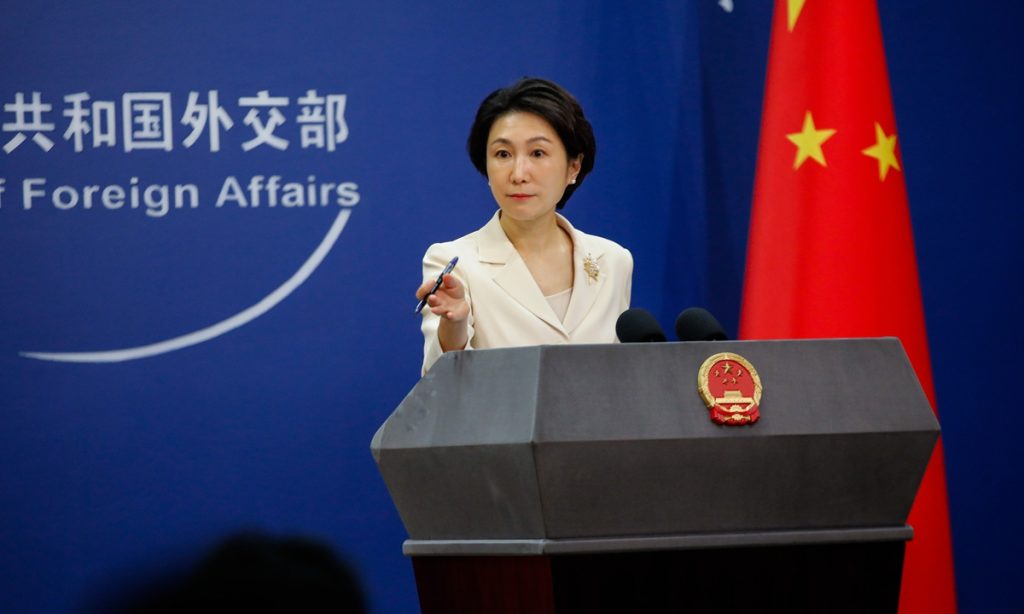
Chinese Foreign Ministry spokesperson Mao Ning said on Wednesday that China is deeply concerned about the current Middle East situation, stressing that a renewed outbreak of hostilities serves the interests of no party and urging all relevant parties to cherish the opportunity for peace, honor their ceasefire commitments, maintain the momentum of negotiations, and adhere to political and diplomatic means to resolve disputes.
Mao made the remarks when asked to comment on reports that the US Central Command said on social media on June 2 (US Eastern Time) that US forces had intercepted multiple ballistic missiles and drones launched by Iran and carried out what it described as a "self-defense" strike on Iran's Qeshm Island. Reports also said that Iran subsequently launched attacks on US military bases in the Middle East, while air-defense sirens sounded across several Gulf countries, further escalating tensions in the region.
In response, Mao also called for an early realization of a comprehensive and lasting ceasefire and for creating the necessary conditions to restore peace and stability in the Gulf region and the broader Middle East.
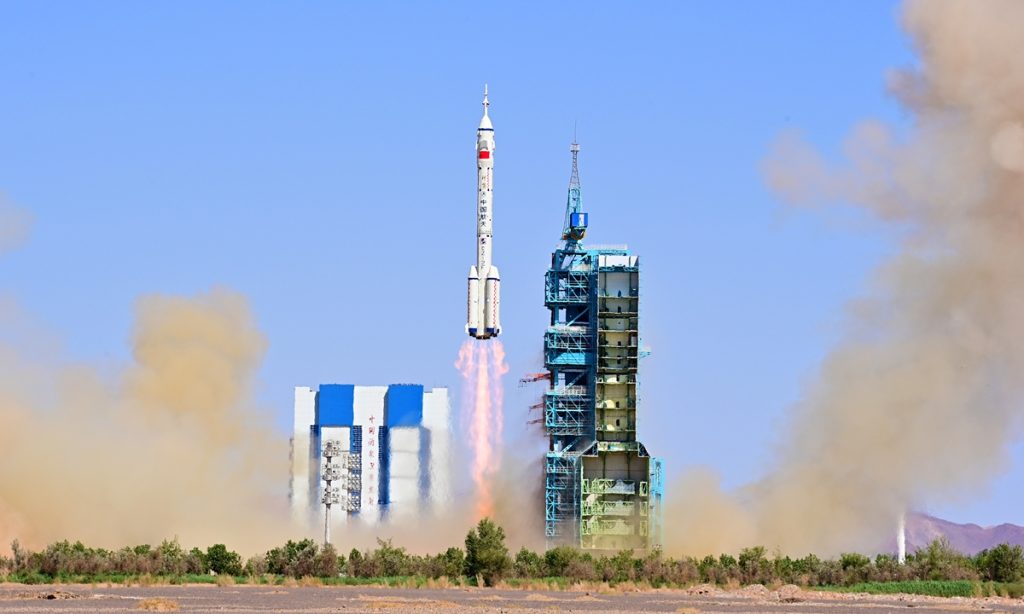
China's Shenzhou-22 crewed spaceship undocked from the space station combination at 2:44 p.m. (Beijing Time) on Friday, and will commence the return mission of sending the Shenzhou-21 astronauts Zhang Lu, Wu Fei and Zhang Hongzhang back to Earth, according to the China Manned Space Agency (CMSA).
The spaceship is scheduled to return to the Dongfeng landing site in north China's Inner Mongolia Autonomous Region later.
The CMSA said that prior to the separation, the Shenzhou-21 crew, with the assistance of the ground staff, completed various tasks such as setting the status of the space station combination, processing and transmitting the experimental data, and transferring remaining supplies. The Shenzhou-21 crew also carried out handover work and exchanged in-orbit work experience with the Shenzhou-23 crew who entered the space station on May 25.
China launched the Shenzhou-21 spaceship on Oct. 31, 2025 to send the Shenzhou-21 crew to its space station for rotation with Shenzhou-20 crew. However, the Shenzhou-20 crew later found that Shenzhou-20 spaceship's return capsule viewport window suffered a suspected impact from space debris during its mission and was unfit for crew return mission.
On Nov. 14, 2025, the Shenzhou-20 crew returned safely aboard the Shenzhou-21 spacecraft. On Nov. 25, 2025, China launched the Shenzhou-22 spaceship to provide a return vessel for the Shenzhou-21 crew.
Visiting Chinese Foreign Minister Wang Yi said on Friday that China looks forward to working with Canada to jointly advance the China-Canada new strategic partnership.
Wang made the remarks during talks with former Canadian Prime Minister Jean Chretien.
Wang, also a member of the Political Bureau of the Communist Party of China Central Committee, said that Chretien initiated the "golden decade" of China-Canada relations during his tenure as prime minister.
The improvement in China-Canada relations meets the aspirations of both peoples, Wang said, adding that China looks forward to working with Canada to jointly advance the China-Canada new strategic partnership.
Highlighting China's rapid development, Chretien said that the economies of Canada and China are highly complementary.
He expressed his willingness to make contributions to friendly exchanges between the two nations.
A total of 754 million domestic passenger trips were made in China in the first seven days of the 8-day National Day and Mid-Autumn Festival holidays, a year-on-year increase of 78.9%. Holiday tourism generated 668.1 billion yuan ($92.80 billion), up 132.6% year-on-year, official data showed on Friday.
After 276 days in orbit, China's reusable experimental spacecraft landed at its planned site at the Jiuquan Satellite Launch Center in Northwest China's Gansu Province on Monday, and Chinese space watchers said it was a milestone in China's efforts to develop a fully reusable space transportation system.
The success is an important breakthrough in China's research on reusable spacecraft technologies, which will provide more convenient and affordable round trips for the peaceful use of space, the Xinhua News Agency said on Monday.
China launched a reusable experimental spacecraft using its Long March-2F carrier rocket from the Jiuquan Satellite Launch Center on August 5, 2022, to test reusable technologies and in-orbit service technologies to support the peaceful use of space, Xinhua previously reported.
China tested the reusable experimental spacecraft in September 2020, and the spacecraft returned to the planned landing site after two days in orbit. The spacecraft was also launched with a Long March-2F carrier rocket.
Chinese authorities have disclosed few details about the craft's technology. So far, no images of the spacecraft or footage of its launch or landing have been disclosed.
Many space lovers compared it to the US Air Force's X-37B, an autonomous Boeing space plane that can remain in orbit for long periods before returning to Earth on its own, saying that the technology used in the experiment is "too advanced to show" on social media.
The reusable spacecraft's technology has evidently matured, considering how much longer it can stay in orbit, Chinese space watchers noted on Sunday.
Song Zhongping, a space expert and TV commentator, told the Global Times on Monday that the reusability of such spacecraft would drastically reduce costs. More importantly, the longer orbiting time means that the spacecraft can perform more complicated missions such as changing trajectory in near-Earth orbit and sending various payloads into orbit.
Judging from the rocket used in the launch, the Long March-2F carrier rocket - which is one of China's most advanced and reliable rockets for manned space flights - the reusable spacecraft may be used in future manned missions, said another space observer, speaking on condition of anonymity.
Given the payload launching capability of the Long March-2F, the spacecraft could weigh around 8 tons, which is very similar to the launch mass for the X-37B at around 5 tons, so that speculation about their similarity is not groundless, the observer said.
The latest test of the reusable spacecraft was the longest, most complicated, and most challenging so far. The record of 276 days in orbit even beat the first mission of the US' X-37B in 2010, which remained in orbit for 224 days, Huang Zhicheng, a space industry expert, told the Global Times on Monday.
At the China Space Conference opening event to mark the April 24 Space of China this year in Hefei, East China's Anhui Province, Wang Wei, an academician of the Chinese Academy of Sciences and director of the research and development department of the state-owned aerospace giant China Aerospace Science and Technology Corp, listed the 10 major scientific and technology problems for the 2023 space development.
Among them is the health monitoring of the power system for the reusable vehicle and an assessment of its service life.
Huang said that one of the many advantages of the reusable spacecraft is that it can land horizontally, which is more comfortable and safer for the crew. Once it's mature, such technology could be applied to suborbital or space tourism, and even super fast point-to-point transportation for people or cargo on Earth.
The US often hypes and smears China's technology breakthroughs as militarization because it sees all breakthroughs by non-Western countries as a threat. This is meant to maintain a technology monopoly, which is unfair to other countries and serves US hegemony, Chinese experts said.
The high-altitude pressurized liable building independently developed and built by China Construction Third Engineering Bureau Co. Ltd, China's first "zero-altitude astronomical observation station," held a handover ceremony in the Kizilsu Kirghiz Autonomous Prefecture, Northwest China's Xinjiang Uygur Autonomous Region, and was officially delivered for demonstration application, authorities confirmed recently.
"Zero-altitude building" refers to the use of pressurization and other technologies to adjust the indoor key human settlement environment indicators to the low altitude level in the plain area, so that the human body feels more comfortable. When used, the altitude inside the building can be set according to the needs of personnel and reduce the impact of altitude sickness.
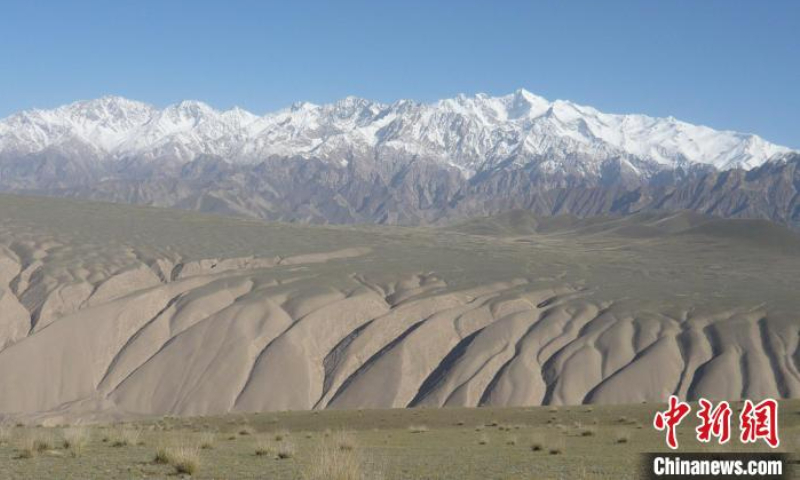
The observatory is located near Muztagh Ata, the third highest peak of the West Kunlun Mountains in Akto county. It sits at an altitude of 4,526 meters, with a total construction area of approximately 150 square meters, capable of supporting scientific research, residential, and office functions.
The observation station is a scientific research pressurized building specially designed for plateau astronomical work in response to the needs of its cooperative organization, Beijing Normal University. It can increase the overall atmospheric pressure inside the building to one standard atmospheric pressure while solving the problems of low pressure and oxygen deficiency in the plateau.
The facility provides a comfortable and healthy environment for astronomers to work and live in high-altitude areas, lowering the risk of physiological damage caused by the plateau's extreme environment.
It is expected to support a new phase of rapid development in China's astronomical scientific research work, according to media reports.
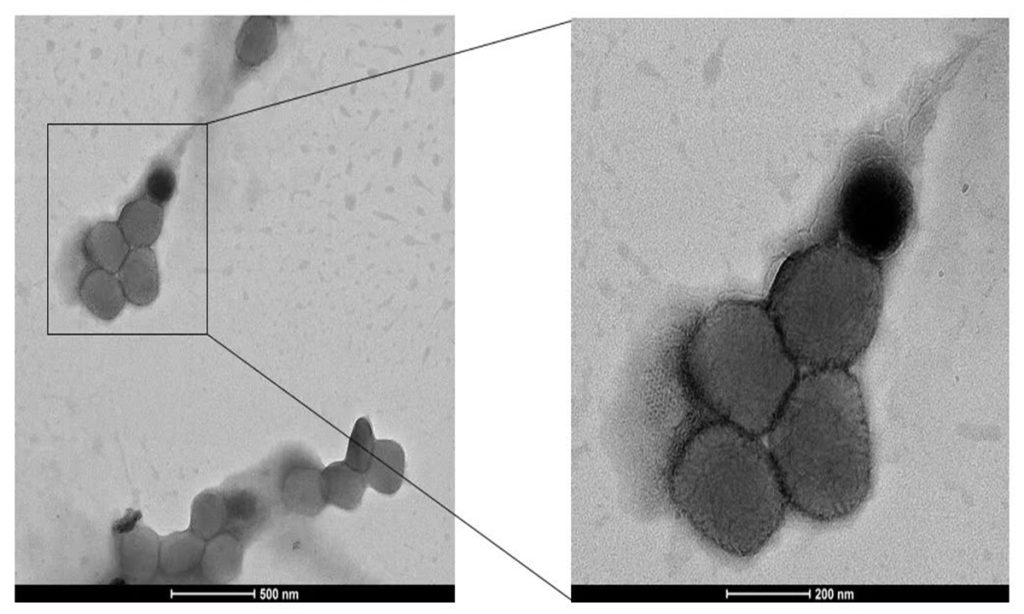
China saw a fourfold surge of monkeypox cases in July compared to the previous month, but experts reached by the Global Times noted on Friday noted that China's home-developed vaccine will soon enter the clinical trial stage.
They also said that although in most cases people heal on their own, newborns, children, pregnant women and people with immunodeficiency may have a higher risk of developing severe or even fatal conditions.
Due to the mild symptoms caused by the monkeypox virus and the lack of large-scale global outbreaks, research into monkeypox vaccines has been relatively limited worldwide, the experts explained.
Meanwhile, as monkeypox and smallpox viruses have extensive serological cross-reactivity, the existing vaccines used for monkeypox prevention are all smallpox vaccines.
Retrospective studies conducted by the World Health Organization have shown that smallpox vaccine administration has an efficacy of 85 percent in preventing monkeypox. Currently, there are three smallpox vaccines approved for monkeypox prevention in Europe, the US, and Japan, Su Jinfeng, a senior biomedical engineer, told the Global Times.
Su called for accelerated development of new vaccines to protect those at greater risk and to prevent potential outbreaks. However, the expert admitted that the development of vaccines faces several challenges due to the limited number of monkeypox cases in the country and the dispersed population, which makes it difficult to conduct large-scale clinical trials to assess a vaccine's efficacy.
"Currently, the US, Japan and European countries have considered this type of vaccine as a reserve drug. China should also accelerate the development of a new smallpox/monkeypox vaccine, not only to prevent the spread of monkeypox outbreaks but also to protect national security and public health from threats of smallpox virus being used as a bioweapon," a vaccine expert who preferred not to be named told the Global Times.
Given the large genome and complex structure of the monkeypox virus, as well as limited understanding of protective antigens, the development of a protective antigen-based vaccine is challenging, the expert said. Therefore, a better strategy would be to use attenuated live vaccine technology, building upon the existing smallpox vaccine, to develop a safer vaccine in human cells.
As of April 2023, preclinical research on monkeypox vaccines has been conducted primarily by the US and China, said Su. Previous reports have indicated that a total of 14 clinical studies on monkeypox vaccines have been conducted globally.
Currently, three types of vaccine have been approved for the prevention of monkeypox, from Denmark, the US, and Japan.
Research institutions in China have already started developing monkeypox vaccines, mainly focusing on replication-defective monkeypox attenuated live vaccines and monkeypox mRNA vaccines.
In July, the replication-deficient monkeypox vaccine developed by China National Pharmaceutical Group Corporation (Sinopharm) has passed the clinical trial application with the National Medical Products Administration, making it the earliest domestically developed monkeypox vaccine to enter the clinical research stage in China.
The Chinese mainland has reported 491 new monkeypox cases across 23 provincial-level regions, the country's Center for Disease Control and Prevention confirmed on Wednesday, increasing over fourfold compared to last month.
According to epidemiological reviews, all cases are male with 96.3 percent of them identified as men who had sex with other men, and the risk of transmission through other contact methods is low.
The majority of cases exhibited typical clinical symptoms including fever, rash, and swollen lymph nodes, with no severe or fatal cases.
In order to prevent any impact caused by Japan's dumping of Fukushima nuclear-contaminated wastewater into the Pacific Ocean, more countries, especially those in the Asia-Pacific like China, Thailand and Russia, are taking actions, including strengthened testing of aquatic products imported from Japan, while more people and organizations from South Korea and the Pacific Island countries are voicing their opposition and concern over Tokyo's decision.
Although the US said it is "satisfied" with Japan's act, which has caused fury and concern worldwide, the US is in fact the country that has seen the greatest reduction in imports of Japanese seafood and rice wine, media reported, citing data published by Japan's Ministry of Agriculture, Forestry and Fisheries.
Experts said this has exposed the hypocrisy of Washington to trade permission for Japan's dumping for Tokyo's loyalty to serve its geopolitical strategy, and that the administration of US President Joe Biden cares less about the safety and environmental protection that seriously matters to the US people. The US priority is geopolitics and US hegemony, as its poor handling of the Hawaii wildfires and hypocritical response to Japan's nuclear-contaminated water dumping plan are hard evidence of this.
The Japanese government said on Saturday that "no detectable amount of tritium was found in the first fish samples taken in waters near the Fukushima nuclear plant." The fish samples, "a gurnard and olive flounder," were collected Friday within five kilometers of the dumping outlet of the Fukushima Daiichi complex, the Fisheries Agency of Japan said on its website.
This information release just caused more suspicion among the public, as many netizens on Chinese social media networks asked "why the Japanese government only took two fish to sample." They doubted the credibility of the detection and research results that are provided by the Japanese government.
According to South Korean media Hankyoreh on Friday, South Korean experts on nuclear energy are concerned that after public attention toward the dumping declines, the Japanese government will dump the nuclear-contaminated wastewater more recklessly, as Japan has consistently denied South Korea and other relevant countries' requests to directly collect samples.
More countries take actions
After Japan started dumping nuclear-contaminated wastewater from the crippled Fukushima Daiichi nuclear power plant into the sea on Thursday, more and more Asia-Pacific countries have taken actions in response. Apart from China's decision to suspend imports of all aquatic products from Japan, Thailand and Russia vowed to tighten control and strengthen testing of aquatic product imports from Japan.
The Food and Drug Administration of Thailand said if the seafood imported from Japan exceeds the standard of radiation and other relevant indexes, the country is ready to order a recall and suspend imports, according to Thai media PPTV.
According to Singapore media zaobao.com, as Thailand is located in the area with high risks caused by Japan's dumping of nuclear-contaminated water, the Thai governmental departments of fisheries, food and drug administration, nuclear energy and other relevant agencies have had an emergency meeting, where they decided to strengthen supervision measures. Thai officials said that Thai customs and relevant departments that conduct inspections of imported seafood are being prepared.
Russia's quarantine agency has tightened quality control of seafood imported from Japan after the dumping of nuclear-contaminated wastewater started, the Xinhua News Agency reported on Friday.
In a news release issued on Thursday, the Federal Service for Veterinary and Phytosanitary Supervision of Russia said that "Russia shares the concerns of many countries regarding the impact of nuclear-contaminated wastewater discharge on food safety, thus the agency introduces a regime of enhanced control on radiological parameters of fish and seafood imported from Japan."
"If an excess of radioactive material is detected, restrictive measures will be taken in relation to the supply of such goods from Japan," the Russian agency said.
Analysts said the Japanese government has put in a lot of resources to buy "support" or "understanding" from other countries and regions, as it understands that some countries are concerned or opposed to Japan's irresponsible decision, especially countries and regions in the Asia-Pacific. However, even if some countries did not express open oppositions, they are taking serious actions to handle the impacts.
Rising concerns
In some other countries, concern and opposition against Japan's actions have increased, despite their governments remaining silent or exhibiting tolerance toward Tokyo.
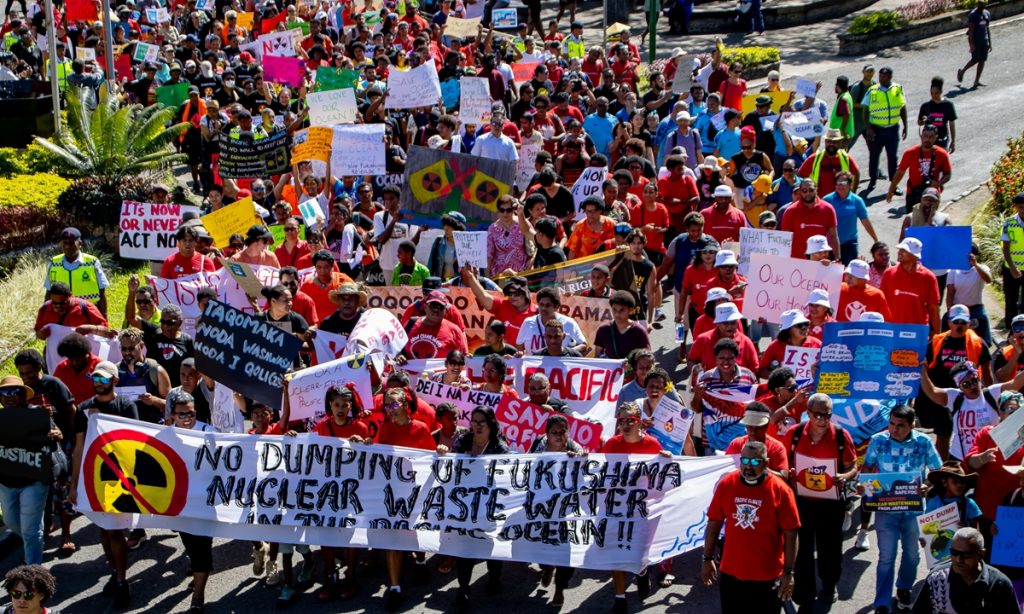
In the Pacific Island Country of Fiji, the Suva Fish Market Association came out strongly on Thursday and stated that it does not agree with the dumping of the Fukushima nuclear-contaminated wastewater into the Pacific Ocean, and they are also concerned over the Fijian government's attitude that "the discharged water is safe," according to Fiji media fijivillage.com.
Samu Maraiwai, president of the association, said the nuclear-contaminated wastewater to be dumped into the Pacific Ocean poses "a risk of massive destruction to our marine ecosystem and our source of livelihood." Maraiwai said the nuclear-contaminated waste will be toxic to a certain level and it will affect the marine ecosystem including fish, seaweeds, corals and other sources of livelihood.
According to South Korean media Yonhap News, about 50,000 people rallied in Seoul on Saturday to "protest Japan's release of radioactive water from the crippled Fukushima nuclear power plant," with the participation of some 90 civic groups which have formed a coalition to protest the dumping of nuclear-contaminated water and members of four opposition parties, including the main opposition Democratic Party (DP).
Occupying four traffic lanes, the protesters chanted slogans and held up signs reading, "Retract disposal of Fukushima contaminated water," and "Denounce the Yoon Suk Yeol administration."
"Japan has crossed a line that shouldn't be crossed," DP leader Lee Jae-myung said from a platform installed for the rally. "Discharging nuclear contaminated water is a declaration of war against nations bordering the Pacific Ocean.
"Japan should apologize to the Republic of Korea, which is its nearest country and is suffering the most damage," he noted. Lee also accused South Korean President Yoon Suk-yeol of justifying and supporting the water dumping when Japan was hesitant out of concern about its neighbors.
US hypocrisy
Defying mounting oppositions and contrary to its self-styled image as a global leader in environmental protection, the US Department of State endorsed Tokyo's controversial dumping of the Fukushima nuclear-contaminated water into the ocean, saying the US is "satisfied with Japan's safe, transparent, and science-based process."
Endorsing Japan's selfish and irresponsible practice that harms the global environment and the health of human beings in the planet, the US has trampled on its own image as a leader in global environmental protection, exposing its selfishness and hypocrisy of prioritizing its geopolitical interests above the long-term well-being of people around the world, experts said.
As the US publicly backs the Japanese government's plan to dump nuclear-contaminated water into the ocean, media reports quoting data from the Ministry of Agriculture, Forestry and Fisheries of Japan revealed that the US was making the biggest moves in decreasing imports of agricultural and aquatic products from Japan in the first half of 2023.
Data showed that the US is the country that reduced imports of Japanese agriculture, forestry and fishery products the most in the first half of the year, with imports down by 8.3 billion yen ($57 million). The main production areas of the three kinds of products are all in areas affected by the dumping of nuclear-contaminated water, according to media reports.
Though well aware of the risks brought about by the nuclear-contaminated water to surrounding oceans and the entire global environment, the US has succumbed to its political interests and is going against its image as a leader of environmental protection activism, Lü Chao, an expert on Korean Peninsula issues at the Liaoning Academy of Social Sciences, told the Global Times on Saturday.
"It is laughable to see the hypocrisy and double standards held by the US by covering up Japan's extremely selfish and irresponsible wrongdoing," Lü said.
"Acts and deeds from the US show that it purely considers Japan's act of harming the global environment and human beings of all countries from a geopolitical perspective. The US's real intention is to tie Japan to its chariot of geopolitical games," Li Haidong, a professor at the China Foreign Affairs University, told the Global Times on Saturday.
Without the indulgence of the US, the Japanese decision to dump nuclear- contaminated water would not have been so arbitrary. Japan opened a Pandora's box on Thursday with the strong backing of the US, allowing crisis to plague other countries and the international community, Li noted.