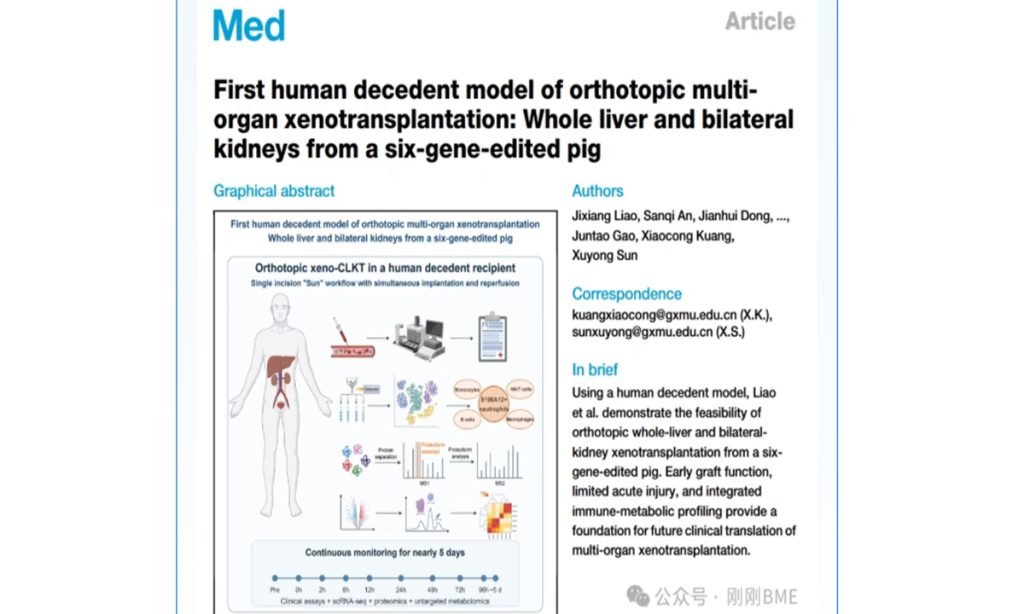
A Chinese medical team has reportedly performed the world's first combined xenotransplantation of a gene-edited pig liver and two pig kidneys into a human body, marking a huge milestone in the exploration of multi-organ xenotransplantation.
According to a post on the official WeChat account of the Second Affiliated Hospital of Guangxi Medical University on Monday, the procedure was carried out by a medical team led by Professor Sun Xuyong from the hospital and involved an orthotopic transplant, meaning the organs were placed in their normal anatomical positions. The recipient was a 53-year-old brain-dead man, and the surgery was performed with the consent of his family.
The team used gene-edited Bama miniature pigs from Guangxi as the source of the donor organs. The donor pigs underwent six precise genetic edits, including the removal of key genes that can trigger hyperacute rejection in humans and the insertion of human genes related to blood clotting and immune compatibility, the Xinhua News Agency reported on Wednesday.
During five days of systematic monitoring, the transplanted organs showed encouraging physiological signs, with generally normal blood supply as well as observed bile secretion and urine production, according to the post.
The research was published in Med, a Cell Press journal, on May 29, 2026, and was later featured by Nature, drawing wider attention from the global academic community, media reported.
Leonardo Riella, a physician-scientist at Harvard University and Massachusetts General Hospital who led the team behind the world's first living-recipient pig kidney transplant in 2024, said multi-organ xenotransplantation is more complex than single-organ transplantation, but the study showed that it is technically feasible.
Set to be held in the US, Canada and Mexico from June 11 to July 19, this year's World Cup tournament will see 48 teams contesting for the first time in the tournament's history. Although the Chinese men's national soccer team did not qualify for the World Cup, the country's presence will be palpable.
With less than a week before kickoff, this year's World Cup has yet to generate strong buzz in China, possibly due to time zone differences and other factors. But there is no such lag for Chinese companies, which are already engaging with the event at a higher and more advanced level.
China's footprint at this year's World Cup highlights a shift from low-cost manufacturing to stylish, original designs, alongside the contribution of Chinese referees and officiating technologies. This evolving role is driven by innovation and advanced technology. Guy-Laurent Epstein, UEFA events marketing director, told the People's Daily that Chinese companies are no longer mere commercial sponsors buying ad space, but are instead bringing cutting-edge technological innovations directly into UEFA's tournament systems.
Upgraded innovation
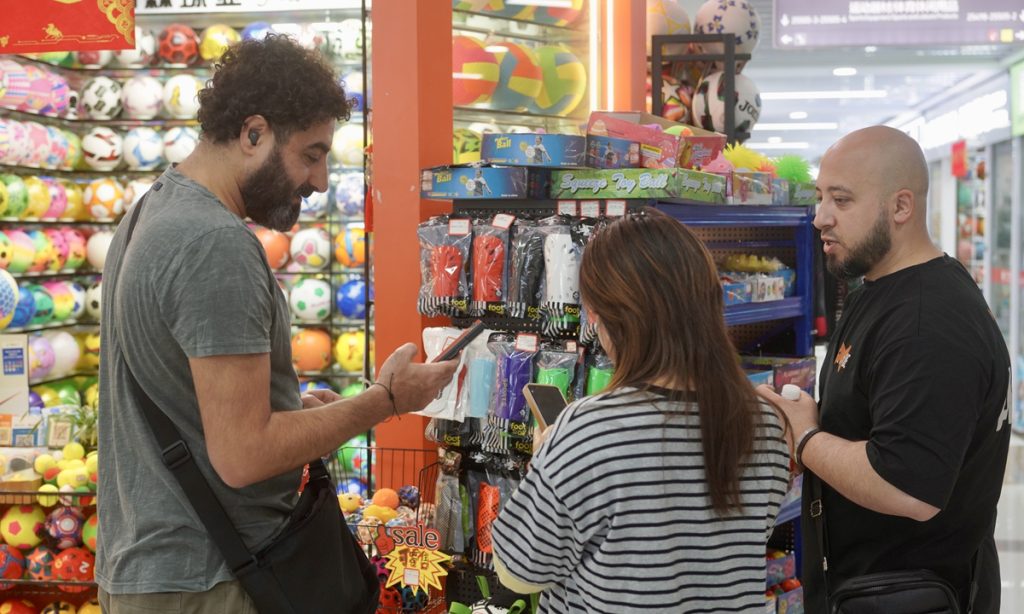
In Yiwu, the world's supermarket in East China's Zhejiang Province, brightly colored commemorative soccer balls stand out vividly. Chen Shaomei, manager of Minsa Sports in the Yiwu International Trade Market showed the Global Times their popular overseas bestseller - a commemorative soccer ball designed with the signature colors of the three host countries: the US, Canada, and Mexico.
"This is our self-designed, self-manufactured, and self-branded commemorative ball," Chen told the Global Times on Sunday.
This is the sixth World Cup that Chen has participated in as a merchant. Chen's company has been deeply engaged in the ball industry for many years, with 90 percent of its products exported overseas.
Chen said Chinese manufacturing, including that of Yiwu, has moved beyond competing primarily on price and now stands out through creative design and higher-quality advantages. "Our greatest strength lies in our unique designs," he noted.
Beijing-based sports and e-commerce retail company All Star Partner secured official World Cup licensing rights for multiple popular national teams. Jin Ye, chief operating officer of the company, told the Global Times on Sunday that truly vibrant and enduring products must integrate team culture, fans' emotions, and real-life usage scenarios.
"Fans cannot express their passion only inside the stadium - they showcase their identity while shopping, traveling, going to school, commuting, attending parties, and sharing on social platforms. Therefore, we are developing more lifestyle-oriented products such as casual T-shirts, hats, bags, plush pendants, cups, neck pillows, canvas shoes, and more, allowing national team IPs to truly become part of everyday life," Jin said.
In the past, when people thought of Chinese companies participating in international sports events, they mainly associated them with manufacturing and supply chain capabilities. However, soon Chinese enterprises will not only be capable of producing products, but also of participating in design, brand expression, and user engagement - thereby influencing the commercialization strategies of international IPs in the Chinese and broader Asian markets in return, Jin noted.
The export sports enterprise Kelme, leveraging its strong technological innovation advantages, will be the official jersey sponsor for the national teams of Jordan and Bosnia and Herzegovina, according to Fujian Daily.
"We use new functional sports fabrics that give the jerseys multiple advantages, including moisture absorption, quick drying, and excellent breathability. The entire jersey weighs less than 140 grams, making it lightweight, form-fitting, and skin-friendly. Professional players have praised it as 'breathing armor,'" said Yang Yuanchang, deputy director of the international marketing department of the company, Fujian Daily reported.
Hu Qimu, a professor at the Maritime Silk Road Institute of Huaqiao University, told the Global Times on Sunday that these creative products not only enrich the supply of the World Cup, but also serve as a vivid reflection of the country's industrial transformation and upgrading.
"From relying primarily on price competition in the past to now shifting toward creative design and independent branding, Chinese enterprises have enhanced their competitiveness through continuous innovation," Hu said.
High-tech support
Beyond this presence, some Chinese technology companies are building a solid "technological foundation" for the tournament.
As FIFA's Official Technology Partner, Lenovo is providing AI equipment, services, and solutions for this World Cup. According to a statement sent to the Global Times on Sunday, the company said that during the event, its 3D Digital Human Visualization Solution will be officially applied to the refereeing system and event broadcasting.
The system uses 3D modeling and next-generation generative AI technology to create 3D virtual avatars for the players of this tournament. Particularly in offside replay segments, they offer both on-site and online audiences more intuitive visual interpretations, while accurately replicating each player's body dimensions and features, greatly enhancing the credibility and transparency of refereeing decisions, said the company.
As the "media heart" of this World Cup, the 2026 FIFA World Cup International Broadcast Centre, located in Dallas, the US, has selected Hisense as its dedicated display equipment provider.
The company told the Global Times that Hisense's technology accurately reproduces every detail of the on-field action, which will assist Video Assistant Referees in making precise decisions and supporting high-quality event broadcasting.
Hu noted that the participation model of Chinese companies in major sporting events has evolved from an early focus on seeking exposure to applying their technologies in real overseas scenarios.
International media outlets including Reuters have also observed that Chinese companies are undergoing a major transformation in their role at top-tier international sporting events, evolving from peripheral merchandise suppliers into key providers of core technological infrastructure, the People's Daily reported.
Hu noted that Chinese enterprises are not only achieving brand promotion and business expansion through sports marketing, but are also leveraging their capabilities to provide high-quality products and drive improvements in event organization.
As Chinese companies participate more deeply in top-tier international events, the future international sports arena is likely to see more "Chinese technology" and "Chinese solutions," the expert added.
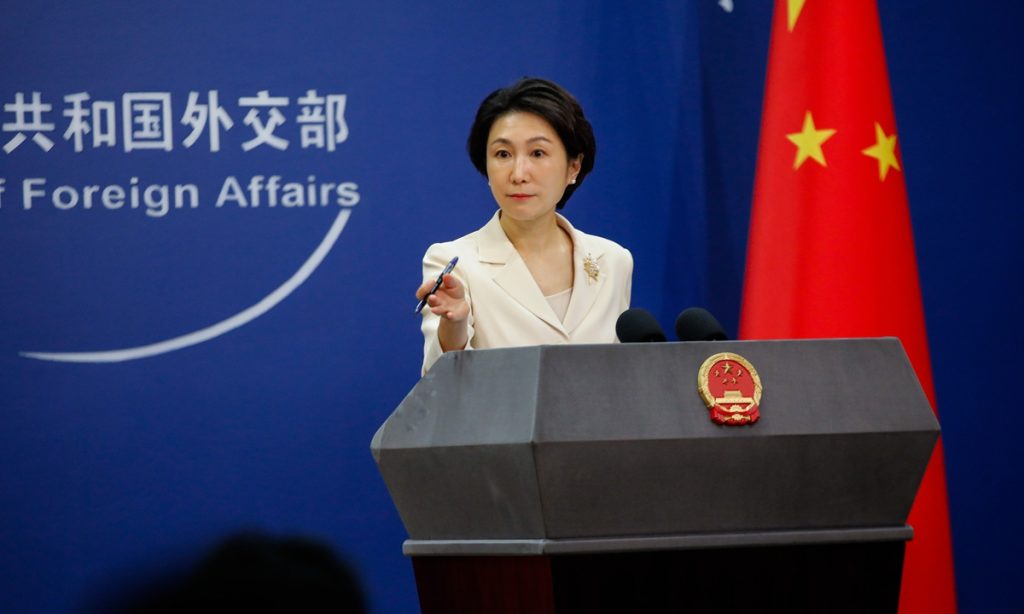
Chinese Foreign Ministry spokesperson Mao Ning said on Wednesday that China is deeply concerned about the current Middle East situation, stressing that a renewed outbreak of hostilities serves the interests of no party and urging all relevant parties to cherish the opportunity for peace, honor their ceasefire commitments, maintain the momentum of negotiations, and adhere to political and diplomatic means to resolve disputes.
Mao made the remarks when asked to comment on reports that the US Central Command said on social media on June 2 (US Eastern Time) that US forces had intercepted multiple ballistic missiles and drones launched by Iran and carried out what it described as a "self-defense" strike on Iran's Qeshm Island. Reports also said that Iran subsequently launched attacks on US military bases in the Middle East, while air-defense sirens sounded across several Gulf countries, further escalating tensions in the region.
In response, Mao also called for an early realization of a comprehensive and lasting ceasefire and for creating the necessary conditions to restore peace and stability in the Gulf region and the broader Middle East.
China's Shenzhou-22 crewed spaceship undocked from the space station combination at 2:44 p.m. (Beijing Time) on Friday, and will commence the return mission of sending the Shenzhou-21 astronauts Zhang Lu, Wu Fei and Zhang Hongzhang back to Earth, according to the China Manned Space Agency (CMSA).
The spaceship is scheduled to return to the Dongfeng landing site in north China's Inner Mongolia Autonomous Region later.
The CMSA said that prior to the separation, the Shenzhou-21 crew, with the assistance of the ground staff, completed various tasks such as setting the status of the space station combination, processing and transmitting the experimental data, and transferring remaining supplies. The Shenzhou-21 crew also carried out handover work and exchanged in-orbit work experience with the Shenzhou-23 crew who entered the space station on May 25.
China launched the Shenzhou-21 spaceship on Oct. 31, 2025 to send the Shenzhou-21 crew to its space station for rotation with Shenzhou-20 crew. However, the Shenzhou-20 crew later found that Shenzhou-20 spaceship's return capsule viewport window suffered a suspected impact from space debris during its mission and was unfit for crew return mission.
On Nov. 14, 2025, the Shenzhou-20 crew returned safely aboard the Shenzhou-21 spacecraft. On Nov. 25, 2025, China launched the Shenzhou-22 spaceship to provide a return vessel for the Shenzhou-21 crew.
Visiting Chinese Foreign Minister Wang Yi said on Friday that China looks forward to working with Canada to jointly advance the China-Canada new strategic partnership.
Wang made the remarks during talks with former Canadian Prime Minister Jean Chretien.
Wang, also a member of the Political Bureau of the Communist Party of China Central Committee, said that Chretien initiated the "golden decade" of China-Canada relations during his tenure as prime minister.
The improvement in China-Canada relations meets the aspirations of both peoples, Wang said, adding that China looks forward to working with Canada to jointly advance the China-Canada new strategic partnership.
Highlighting China's rapid development, Chretien said that the economies of Canada and China are highly complementary.
He expressed his willingness to make contributions to friendly exchanges between the two nations.