LONGi BC Technology Powers 'Infinite Apollo' Through Road Test in Belgium
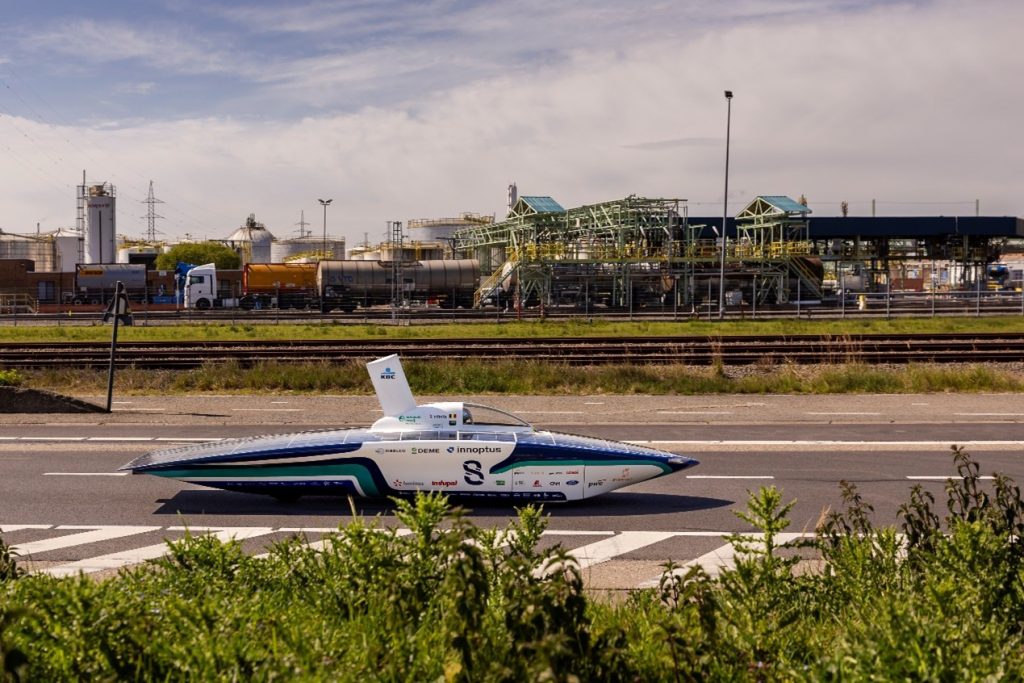
The Innoptus Solar Team, a world-leading solar racing team, completed a 200 km "Solar Home Run" urban tour across Belgium, supported by local government and key partners. The 11th-generation solar race car, Infinite Apollo, equipped with LONGi's high-efficiency back-contact (BC) cells, drove on urban roads under real traffic conditions and variable solar irradiance, providing real-world validation of LONGi's BC technology in complex operating conditions.
The event follows Innoptus Solar Team's announcement that LONGi would provide BC technology and flexible photovoltaic solutions to support the team in the upcoming American Solar Challenge (ASC) on March 23, 2026. The Belgian road tour serves as a critical pre-race validation of the vehicle's capabilities on European urban roads, ahead of its participation in North America's premier solar race.
Prior to this, Infinite Apollo completed full vehicle assembly after 10 months of development and entered a testing phase that includes several thousand kilometers of real-road driving across Belgium. The program is designed to push vehicle performance over long distances and diverse driving conditions, laying the groundwork for what is expected to be the longest and most demanding solar race in the team's history. The Belgian tour is a key milestone in that broader testing campaign.
BC Technology Leadership: Proven in the Real World
Real leadership in photovoltaic technology is not defined by laboratory efficiency records alone, but by reliable performance under real-world conditions. The Solar Home Run brought together a complete, high-performance PV value chain. Sibelco, a key team partner, supplies high-purity quartz sand for advanced PV cell manufacturing. LONGi converts that material capability into high-efficiency BC cells and vehicle-integrated photovoltaic (VIPV) system solutions — delivering enhanced energy yield while maintaining stable operation in complex scenarios. Innoptus Solar Team then integrates the full system into a race-ready vehicle, creating a complete chain from raw materials to cells, and from subsystems to a fully operational solar car.
That closed-loop capability was validated on public roads. The solar race car navigated live traffic, changing light conditions, and continuous driving between six stops in a single day — Sibelco, Indupol, DEME, PwC Belgium, KBC, and 4itego/Innoptus — systematically verifying the high efficiency and reliability of LONGi BC technology.
Across a dynamic mix of stop-and-go, sustained cruising, and multi-point stops, Infinite Apollo maintained stable, predictable output. The run marks the car's first return to European urban roads since completing the grueling 3,000 km Bridgestone World Solar Challenge (BWSC) last August. The results reinforce a core attribute of LONGi's BC products: high efficiency with real-world usability — capable not only of high-speed desert racing but also of stable, dependable driving on everyday city roads.
Moving from static display to a proven "perform, deliver, endure" capability, Infinite Apollo and LONGi's BC technology earned recognition not only from the R&D team but also from partners, the public, the media, and government representatives — demonstrating the growing potential of BC technology for broader mobility applications.
Continuous Evolution: From European Roads to the North American Stage
Long-distance driving, changing local conditions, and real-time route coordination all introduce uncertainty. Yet for a solar racing team — and for LONGi as the exclusive PV solutions partner — that uncertainty is precisely where potential lies. LONGi's approach is to engineer for stable output and system-level reliability despite unpredictable operating environments. That is the foundation of its technological leadership.
The Solar Home Run serves as a critical preparation stage for the American Solar Challenge. Responding to new race regulations and higher technical demands, the Innoptus Solar Team has comprehensively upgraded the vehicle's core systems, including high-performance solar modules, an advanced battery system, and the team's signature aerodynamic design. LONGi continues to collaborate closely, refining its BC technology to support full-system performance gains.
The 2026 American Solar Challenge will begin in July, following the Great River Road and historic Route 66 from the Mississippi River — a course combining technical difficulty with high visibility. Teams must first pass a three-day qualification round at Brainerd International Raceway to secure an entry. From the Australian outback to European city streets, from extreme endurance racing to everyday roads, LONGi's BC technology is evolving along a path of continuous real-world verification.
Beyond Racing: Public Engagement Through LONGi Solar Van
In addition to the tour, LONGi's "Solar Van" — a mobile experience space — traveled from France through Frankfurt to Dessel, the host city of the tour's first stop. Open to the public, the van brought clean energy technology directly into urban public spaces, offering hands-on demonstrations of solar power in real-world mobility. Together, the real-world performance of a solar race car and the interactive experience inside the Solar Van show that sustainable development is not just a long-term goal — but something that people can see, touch, and experience today.