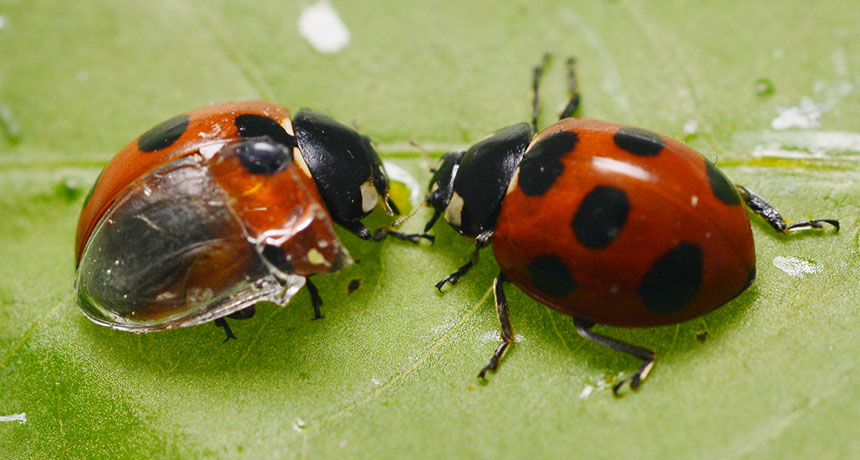
Those who struggle to fit a vacation wardrobe into a carry-on might learn from ladybugs. The flying beetles neatly fold up their wings when they land, stashing the delicate appendages underneath their protective red and black forewings.
To learn how one species of ladybug (Coccinella septempunctata) achieves such efficient packing, scientists needed to see under the bug’s spotted exterior. So a team from Japan replaced part of a ladybug’s forewing with a transparent bit of resin, to get a first-of-its-kind glimpse of the folding. Slow-motion video of the altered ladybug showed that the insect makes a complex, origami-like series of folds to stash its wings, the scientists report in the May 30 Proceedings of the National Academy of Sciences. CT scans helped explain how the wings can be both strong enough to hold the insects aloft and easily foldable into a tiny package. The shape of the wing veins allows them to flex like a metal tape measure, making the wings stiff but bendable. Lessons learned from the wings could be applied to new technologies, including foldable aircraft wings or solar panels that unfurl from a spacecraft.
Climate change may make the rich richer and the poor poorer in the United States.
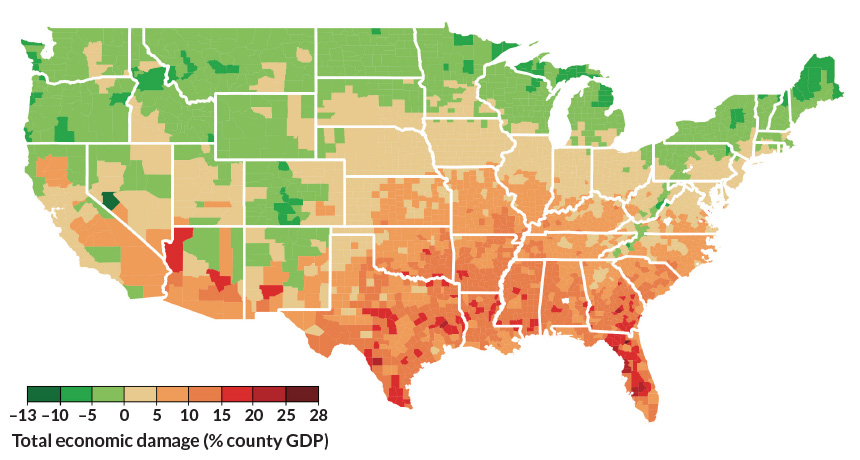
Counties in the South face a higher risk of economic downturn due to climate change than their northern counterparts, a new computer simulation predicts. Because southern counties generally host poorer populations, the new findings, reported in the June 30 Science, suggest that climate change will worsen existing wealth disparities.
“It’s the most detailed and comprehensive study of the effects of climate change in the United States,” says Don Fullerton, an economist at the University of Illinois at Urbana-Champaign who was not involved in the work. “Nobody has ever even considered the effects of climate change on inequality.” Researchers created a computer program called SEAGLAS that combined several climate simulations to forecast U.S. climate until 2100, assuming greenhouse gas emissions keep ramping up. Then, using data from previous studies on how temperature and rainfall affect several economic factors — including crop yields, crime rates and energy expenditures — SEAGLAS predicted how the economy of each of the 3,143 counties in the United States would fare.
By the end of the century, some counties may see their gross domestic product decline by more than 20 percent, while others may actually experience more than a 10 percent increase in GDP. This could make for the biggest transfer of wealth in U.S. history, says study coauthor Solomon Hsiang, an economist at the University of California, Berkeley.
In general, SEAGLAS predicts that counties in the lower Midwest, the South and the Southwest — already home to some of the country’s poorest communities — will bear the brunt of climate-caused economic damages, while counties in New England, the Great Lakes region and the Pacific Northwest will suffer less or see gains. For many of the examined economic factors, such as the number of deaths per year, “getting a little bit hotter is much worse if you’re already very hot,” explains Hsiang. “Most of the south is the hottest part of the country, so those are the regions where costs tend to be really high.” The economic gaps may get stretched even wider than SEAGLAS predicts, Fullerton says, because the simulation doesn’t account for wealth disparities within counties. For example, wealthier people in poor counties may have access to air conditioning while their less fortunate neighbors do not. So blisteringly hot weather is most likely to harm the poorest of the poor.
Not all researchers, however, think the future is as bleak as SEAGLAS suggests. The simulation doesn’t fully account for adaptation to climate change, says Delavane Diaz, an energy and environmental policy analyst at the Electric Power Research Institute in Washington, D.C., a nonprofit research organization. For example, people in coastal regions could mitigate the cost of sea level rise by flood-proofing structures or moving inland, she says.
And the economic factors examined in this study don’t account for some societal benefits that may arise from climate change, says Derek Lemoine, an economist at the University of Arizona in Tucson. For instance, although crime rates rise when it’s warmer because more people tend to be out and about, people being active outside could have a positive impact on health.
But SEAGLAS is designed to incorporate different societal variables as new data become available. “I really like the system,” Lemoine says. “It’s a super ambitious work and the kind of thing that needs to be done.”
Mums are now a flower of a different color. Japanese researchers have added a hint of clear sky to the humble plant’s palette, genetically engineering the first-ever “true blue” chrysanthemum.
“Obtaining blue-colored flowers is the Holy Grail for plant breeders,” says Mark Bridgen, a plant breeder at Cornell University. The results are “very exciting.”
Compounds called delphinidin-based anthocyanin pigments are responsible for the natural blues in such flowers as pansies and larkspur. Mums lack those compounds. Instead, the flowers come in a variety of other colors, evoking fiery sunsets, new-fallen snow and all things chartreuse. In previous attempts to engineer a blue hue in chrysanthemums — and roses and carnations — researchers inserted the gene for a key enzyme that controls production of these compounds, causing them to accumulate. But the resulting blooms skewed more violet-purple than blue. True blue pigment remained elusive, scientists thought, because its origin was complex; multiple genes have been shown to be involved in its generation. But Naonobu Noda, of the National Agriculture and Food Research Organization in Tsukuba, Japan, and colleagues were surprised to find that inserting only two borrowed genes into chrysanthemums created blue flowers. One gene, from Canterbury bells, got the enzyme process started; the other, from butterfly peas, further tweaked the pigment molecules.
Together, the gene double-team transformed 19 of 32 mums, or 59 percent, of the Taihei variety from having pink or magenta blooms into blue beauties. Additional analyses revealed that the blue color arose because of molecular interactions between the tweaked pigment and certain colorless compounds naturally found in many plants, including chrysanthemums. The two-part method could possibly be used in the production of other blue flowers, the researchers report July 26 in Science Advances.
In the United States, cartoon characters are a no-no in cigarette ads, and candy- or fruit-flavored cigarettes can’t be sold. But that’s not the case for e-cigarettes, and these youth-appealing tactics are luring teens who have never used tobacco products to give e-cigs and even cigarettes a try, a new study suggests.
Researchers analyzed surveys of nearly 7,000 kids ages 12 to 17 who had never used a tobacco product as of 2013 to 2014. Teens who recalled seeing or liking e-cigarette ads were 1.6 times as likely to be open to trying e-cigs or to actually try them the next year as kids who didn’t remember the ads, researchers report online March 26 in JAMA Pediatrics. E-cig ads often feature celebrities, cartoons (one product shows a unicorn vomiting a rainbow) or references to sweet flavors, such as Skittles. Past research has shown a link between traditional cigarette advertisements and receptive nonsmoking adolescents going on to light up. Nearly nine out of 10 smokers tried their first cigarette by age 18. Gearing traditional cigarette ads toward teens has been restricted since 1998.
In 2016, more than 2.1 million U.S. middle and high school students reported using e-cigarettes. That same year, an estimated 20.5 million — or four in five — were exposed to e-cigarette ads.
But e-cigarette ads are doing more than hyping vaping, the study suggests. The ads also appeared to nudge some teens and young adults to take up cigarette smoking. Of a larger group of about 10,500 kids ages 12 to 21 who had never used tobacco products, 18 percent recalled seeing or liking e-cigarette ads but not cigarette ads. Five percent of those teens had started to smoke by the next year.
Extrapolating to the U.S. population, “105,000 12- to 21- year olds appear to have smoked their first cigarette because of the influence of e-cigarette advertising,” says John Pierce, a behavioral epidemiologist at the University of California, San Diego. Previous research has found that teens who use e-cigarettes are more likely to smoke traditional cigarettes (SN: 9/19/15, p. 14). The fact that e-cigarette ads may up the risk of smoking “raises an unprecedented concern for adolescent tobacco control,” addiction psychologist Adam Leventhal and epidemiologist Jessica L. Barrington-Trimis, both of the University of Southern California’s Keck School of Medicine in Los Angeles, write in an accompanying editorial in the journal.
In an interview, Leventhal adds that restricting such advertising is an important target for public health campaigns and policies to limit youth use of tobacco products.
Birds can sense Earth’s magnetic field, and this uncanny ability may help them fly home from unfamiliar places or navigate migrations that span tens of thousands of kilometers.
For decades, researchers thought iron-rich cells in birds’ beaks acted as microscopic compasses (SN: 5/19/12, p. 8). But in recent years, scientists have found increasing evidence that certain proteins in birds’ eyes might be what allows them to see magnetic fields (SN: 10/28/09, p. 12).
Scientists have now pinpointed a possible protein behind this “sixth sense.” Two new studies — one examining zebra finches published March 28 in Journal of the Royal Society Interface, the other looking at European robins published January 22 in Current Biology — both single out Cry4, a light-sensitive protein found in the retina. If the researchers are correct, this would be the first time a specific molecule responsible for the detection of magnetic fields has been identified in animals. “This is an exciting advance — we need more papers like these,” says Peter Hore, a chemist at the University of Oxford who has studied chemical reactions involved in bird navigation.
Cry4 is part of a class of proteins called cryptochromes, which are known to be involved in circadian rhythms, or biological sleep cycles (SN: 10/02/17, p. 6). But at least some of these proteins are also thought to react to Earth’s magnetic field thanks to the weirdness of quantum mechanics (SN: 7/23/16, p. 8). The protein’s quantum interactions could help birds sense this field, says Atticus Pinzon-Rodriguez, a biologist at the University of Lund in Sweden who was involved with the zebra finch study.
To figure out which of three cryptochromes is responsible for this quantum compass, Pinzon-Rodriguez and his colleagues examined the retinas, muscles and brains of 39 zebra finches for the presence of the three proteins Cry1, Cry2 and Cry4. The team found that while levels of Cry1 and Cry2 followed a rhythmic pattern that rose and fell over the day, Cry4 levels remained constant, indicating the protein was being produced steadily.
“We assume that birds use magnetic compasses any time of day or night,” says Lund biologist Rachel Muheim, a coauthor on the zebra finch study.
European robins also showed constant levels of Cry4 during a 24-hour cycle, and higher levels during their migratory season. And the researchers in that study found Cry4 in an area of the robin’s retina that receives a lot of light — a position that would help it work as a compass, the study says.
“We have quite a lot of evidence, but [Cry4] is not proven,” says Henrik Mouritsen, an animal navigation expert at the Institute of Biology and Environmental Sciences in Oldenburg, Germany, who participated in the robin study. More definitive evidence might come from observing birds without a functioning Cry4 protein, to see if they still seem to have an internal compass.
Even then, Hore says, we still may not understand how birds actually perceive magnetic fields. To know, you’d have to be a bird.
There’s a fine line between immersive and unnerving when it comes to touch sensation in virtual reality.
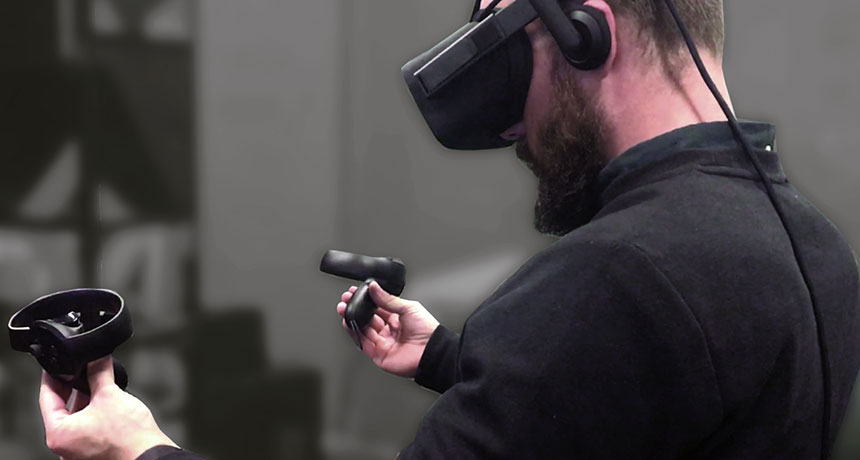
More realistic tactile feedback in VR can ruin a user’s feeling of immersion, researchers report online April 18 in Science Robotics. The finding suggests that the “uncanny valley” — a term that describes how humanoid robots that look almost but not quite human are creepier than their more cartoonish counterparts — also applies to virtual touch (SN Online: 11/22/13). Experiment participants wearing VR headsets and gripping a controller in each hand embodied a virtual avatar holding the two ends of a stick. At first, users felt no touch sensation. Then, the hand controllers gave equally strong vibrations every half-second. Finally, the vibrations were finely tuned to create the illusion that the virtual stick was being touched in different spots. For instance, stronger vibrations in the right controller gave the impression that the stick was nudged on that side.
Compared with scenarios in which users received either no touch or even buzzing sensations, participants reported feeling far less immersed in the virtual environment when they received the realistic, localized touch. This result demonstrates the existence of a tactile uncanny valley, says study coauthor Mar Gonzalez-Franco, a human-computer interaction researcher at Microsoft Research in Redmond, Washington.
But when users were shown a marble touching the virtual stick wherever they felt the localized touch, the participants found this realistic tactile feedback highly immersive rather than bothersome. The finding indicates that rich tactile feedback in VR may need to be paired with other sensory cues that explain the source of the sensation to avoid spooking users, Gonzalez-Franco says.
Better understanding how realistic touch sensations can break the VR illusion may help developers create more engaging virtual environments for games and virtual reality therapy, says Sean Follmer, a human-computer interaction researcher at Stanford University not involved in the study.
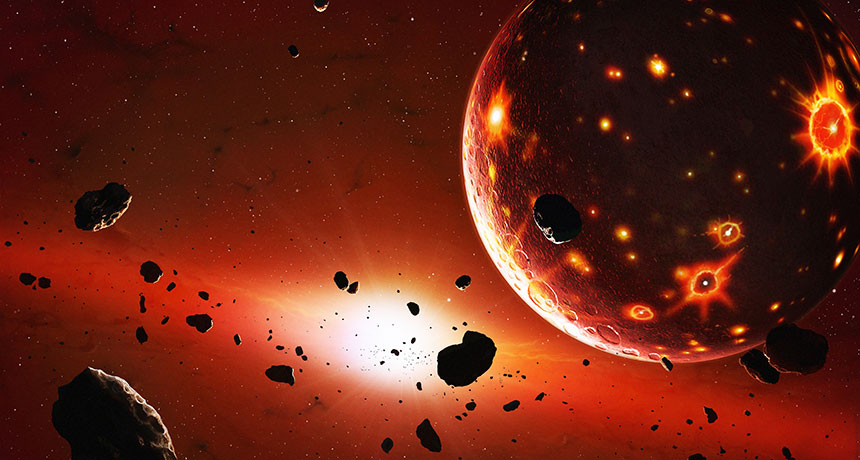
A chunk of space rock may have been forged inside a long-lost planet from the early solar system. Tiny pockets of iron and sulfur embedded in diamonds inside the meteorite probably formed under high pressures found only inside planets the size of Mercury or Mars, researchers suggest April 17 in Nature Communications.
The parent planet no longer exists, though — it was smashed to smithereens in the solar system’s violent infancy.
“We probably have in our hands a piece of one of these first planets that have disappeared,” says Philippe Gillet of École Polytechnique Fédérale de Lausanne, or EPFL, in Switzerland. EPFL physicist Farhang Nabiei, Gillet and their colleagues analyzed minuscule fragments of the Almahata Sitta meteorites. These meteorites are famous for coming from the first-ever asteroid tracked from orbit to ground as it streaked to the Nubian desert in Sudan in 2008 (SN: 4/25/09, p. 13). The meteorites belong to a class called ureilites, which have compositions different from those in any of the known stony planets in the solar system. These ureilites contain 100-micrometer diamonds — too large to have been formed in the shock of two asteroids colliding. Such diamonds could form, however, inside asteroids that are at least 1,000 kilometers in diameter, where pressures would be high enough to compress carbon. But the researchers discovered an oddity that made them question whether the gems came from an asteroid at all: The diamonds had grown around even smaller crystals of iron and sulfur, which normally would repel each other like oil and water, says EPFL physicist Cécile Hébert.
Those crystals would be stable only at pressures above 20 gigapascals, almost 200,000 times atmospheric pressure at sea level on Earth. “That can only be at the center of a very large planet” the size of Mercury, about 4,900 kilometers wide, or in the core-mantle boundary of a planet as large as Mars, about 6,800 kilometers wide, Hébert says.
Such planets probably roamed the early solar system some 4 billion years ago. But only a few survived to become the four rocky planets that exist today. Simulations of the early solar system suggest most of these early planets crashed into each other and broke apart in the first 100 million years.
“We are confirming the existence of such former planets,” Gillet says.
Those planets’ existence alone isn’t surprising, says cosmochemist Meenakshi Wadhwa of Arizona State University in Tempe. “This is the first time, though, that there is direct meteoritic evidence for the existence of a large protoplanetary body in the early solar system that is no longer in existence,” she says. Not so fast, says cosmochemist Martin Bizzarro of the Natural History Museum of Denmark in Copenhagen. The protoplanet explanation isn’t the only one possible.
“They’ve done very careful work,” he says, but more needs to be done. Testing for remnant magnetic fields could reveal if the meteorites were once within a large planet’s molten core, for instance. Whether the meteorites came from a protoplanet is “still an open question.”
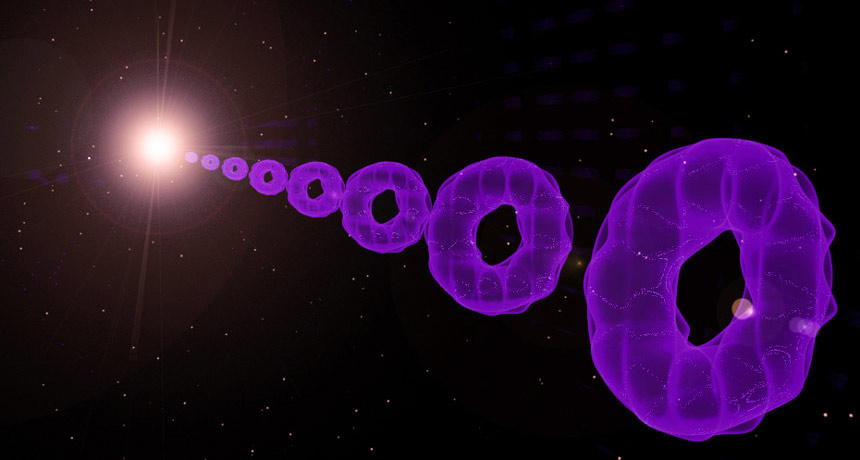
A DIY universe mimics the physics of the infant cosmos, a team of physicists reports. The researchers hope to use their homemade cosmic analog to help explain the first instants of the universe’s 13.8-billion-year life.
For their stand-in, the scientists created a Bose-Einstein condensate — a state of matter in which atoms are chilled until they all take on the same quantum state. Shaped into a tiny, rapidly expanding ring, the condensate grew from about 23 micrometers in diameter to about four times that size in just 15 milliseconds. The behavior of that widening condensate re-created some of the physics of inflation, a brief period just after the Big Bang during which the universe rapidly ballooned in size (SN Online: 12/11/13) before settling into a more moderate expansion rate. In physics, seemingly unrelated systems can have similarities under the hood. Scientists have previously used Bose-Einstein condensates to simulate other mysteries of the cosmos, such as black holes (SN: 11/15/14, p. 14). And the comparison between Bose-Einstein condensates and inflation is particularly apt: A hypothetical substance called the inflaton field is thought to drive the universe’s extreme expansion, and particles associated with that field, known as inflatons, all take on the same quantum state, just as atoms do in the condensate.
Scientists still don’t fully understand how inflation progressed, “so it’s hard to know how close our system is to what really happened,” says experimental physicist Gretchen Campbell of the Joint Quantum Institute in College Park, Md. “But the hope is that our system can be a good test-bed” for studying various theories. Already, the scientists have spotted several effects in their system similar to those predicted in the baby cosmos, the team reports April 19 in Physical Review X.
As the scientists expanded the ring, sound waves that were traveling through the condensate increased in wavelength. That change was similar to the way in which light became redshifted — stretched to longer wavelengths and redder colors — as the universe enlarged. Likewise, Campbell and colleagues saw a phenomenon akin to what’s known as Hubble friction, which shows up as a decrease in the density of particles in the early universe. In the experiment, this effect appeared in the guise of a weakening in the strength of the sound waves in the condensate. And inflation’s finale, an effect known as preheating that occurs at the end of the rapid expansion period, also had a look-alike in the simulated universe. In the cosmic picture, preheating occurs when inflatons transform into other types of particles. In the condensate, this showed up as sound waves converting from one type into another: waves that had been sloshing inward and outward broke up into waves going around the ring.
However, the condensate wasn’t a perfect analog of the real universe: In particular, while our universe has three spatial dimensions, the expanding ring didn’t. Additionally, in the real universe, inflation proceeds on its own, but in this experiment, the researchers forced the ring to expand. Likewise, there were subtle differences between each of the effects observed and their cosmic counterparts.
Despite the differences, the analog universe could be useful, says theoretical cosmologist Mustafa Amin of Rice University in Houston. “Who knows?” he says. “New phenomena might happen there that we haven’t thought about in the early universe.”
Sometimes, when research crosses over between very different systems — such as Bose-Einstein condensates and the early universe — “sparks can fly,” Amin says.
A new kind of navigation system could help self-driving cars take the road less traveled.
Most autonomous vehicles test-driving in cities navigate using 3-D maps marking every curbside and off-ramp with almost centimeter-level precision (SN Online: 11/21/17). But there are millions of miles of open road that tech companies aren’t likely to plot in such detail any time soon.
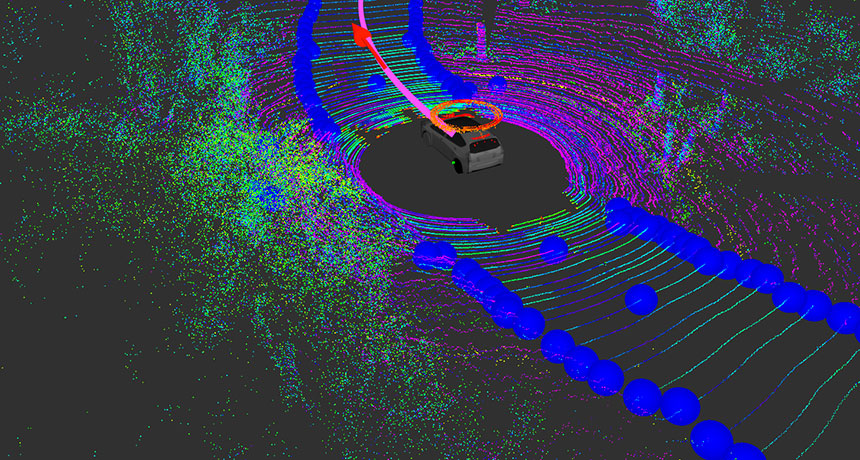
Researchers now have developed a new autonomous navigation system that guides vehicles without such high-res maps, according to research being presented May 22 at the IEEE International Conference on Robotics and Automation in Brisbane, Australia. Cars equipped with this tech could hit the road for excursions off the beaten path. The navigation system charts a course down unfamiliar roads much like a human driver would — by continually scanning its surroundings, albeit with a laser sensor, to gauge how close it is to the edges of the road. Meanwhile, the car also follows a tool akin to a smartphone map app that provides GPS directions to its destination, as well as information about the rules of the road — like speed limits and the positions of stoplights — along the car’s journey.
This system assumes that a car has a clear path down the road, but it could be paired with other existing algorithms that use laser sensing to detect in-road obstacles, like other vehicles or pedestrians, to navigate more heavily trafficked roadways, says study coauthor Teddy Ort, a roboticist at MIT.
Ort and colleagues test-drove a car equipped with this navigation system on a one-lane road winding through a forest in Devens, Mass. The vehicle slowly cruised along a one-kilometer stretch without requiring any human intervention to keep it on the right track. The researchers plan to build a version of this system that can spot lane markings painted on streets, so that the car can drive on more than one-way roads, Ort says. The technology may be useful for future self-driving cars on cross-country road trips, though such vehicles would probably still use meticulous 3-D maps to weave through city traffic, says Raghvendra Cowlagi, an aerospace engineer at Worcester Polytechnic Institute in Massachusetts who wasn’t involved in the work.
Self-driving cars with this navigation system may also need other kinds of sensors to work in different conditions, says Alexander Wyglinski, an electrical and computer engineer also at Worcester Polytechnic Institute not involved in the study. Since laser sensors don’t work well in rain or snow, for example, these cars might need additional imaging technologies to drive safely in inclement weather (SN: 12/24/16, p. 34).
Pulling DNA out of bottles of seawater collected from reefs has revealed some of what biologists are calling the “dark diversity” of sharks.
Physicists have their dark matter, known from indirect evidence since humans can’t see it. Dark diversity for biologists means species they don’t see in some reef, forest or other habitat, though predictions or older records say the creatures could live there.
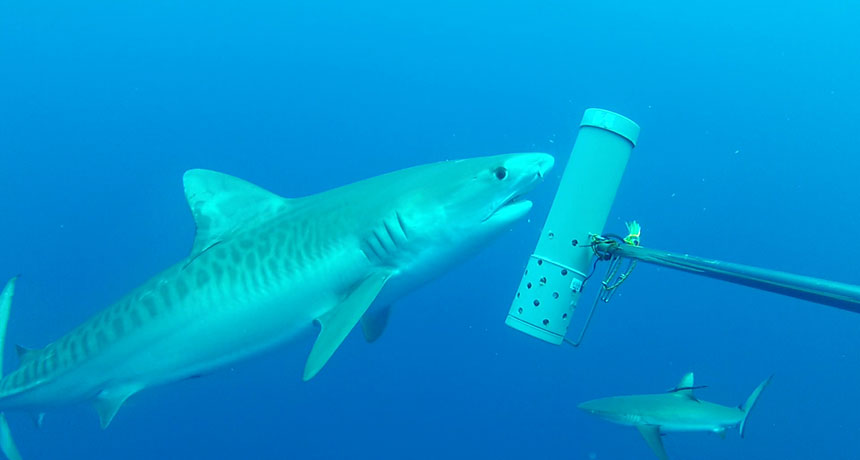
That diversity showed up in a recent comparison of shark sampling methods in reefs in the New Caledonian archipelago, east of Australia. An international team analyzed results from three approaches: sending divers out to count species, baiting cameras and analyzing traces of DNA the animals left in the environment. Environmental DNA revealed at least 13 shark species — at least six of which failed to show up in the other surveys, the team reports May 2 in Science Advances. With environmental DNA, “you reach the inaccessible,” says marine biologist Jeremy Kiszka of Florida International University in Miami.
The six bonus species found only by DNA included a great hammerhead that might have just been passing through. But the bull shark, silky shark and three other kinds were all plausible as reef residents.
Environmental DNA complements rather than replaces other sampling methods, Kiszka says. The DNA method takes less collecting effort, in this case just 22 bottles of seawater. Yet these genetic traces give no information about the number of individuals in an area. What’s more, the DNA failed to register three species — tiger, tawny nurse and scalloped hammerhead — that turned up in the other surveys. Even combining all the methods yielded only 16 kinds of sharks. Reports show that 26 shark species once lived in the shallow waters of the archipelago, so 10 remain in the shadows, either having vanished or escaped detection.